Why must funeral parlors be called "parlors"?
Aside from being an outdated term - what house has a parlor anymore? - the whole funeral industry could do with a little revamping if you ask me. Even the more modern "funeral home", with its fancy couches and dark wood is antiquated.
I say it's high time to add some pizzazz to the death business.
I'm not suggesting we completely do away with the serious send-offs currently in use, especially if that's what people want. But isn't there a little wiggle room here? Why must we always be so stiff and formal? (Ok, stiff I get. Formal, not so much.)
Why not a funky funeral den with, say, a seventies theme? Sunken couches, green glass ashtrays, maybe a little Led Zep or Floyd in the background, a smoke machine. Or for those so inclined, an eighties sendoff, complete with parachute pants, Izod shirts, and the smell of Aqua Net wafting through the air. Cyndi Lauper singing Time after Time could be looped over and over.
How about an "adventure funeral" where friends get to celebrate being alive by jumping from an airplane or dangling from a bungee cord? Although, as a confirmed coward where heights are concerned, I'm not sure how these activities help people celebrate life. But to each his own.
For the more civic-minded among us, we could hold charitable funerals by cleaning up a public park or something equally altruistic. For deceased sports fans we could have baseball or football games.
When you think about it, the possibilities are endless. Yet here we are with the same white funeral homes with black shutters, fancy cars, and empathetic-looking ushers that keep wake lines moving. Just once I'd like to experience something different. Before I croak myself, that is.
Other countries seem much looser with their death rituals than we Americans. In Greece, one funeral tradition was to invite the funniest man in the village and mourners spent the night laughing and celebrating. Tibetan Buddhists practice “Sky Burials” by chopping their dead into pieces and feeding them to birds. The Taiwanese hire bands of strippers to attend funerals and entertain mourners.
So it's not like the whole alternative funeral thing is without precedent. And sure there are pockets of individuality here in the United States . Biker funerals can be pretty interesting, for example. But that's about it as far as I can tell.
Were I to die tomorrow, I'd want all my friends and relatives to come over my house and have their way with my belongings. See a book you like? By all means take it. Know a Grateful Dead fan who might like the 300 or so live shows I've collected over the years? If you do - and chances are, you don't - they're yours for the taking.
After everyone took whatever they wanted, I'd want someone to sell off the rest my belongings and either throw a giant party or donate it to charity. Since I'm already dead in this scenario, I'll leave the choice up to someone else.
Showing posts with label musings. Show all posts
December 16, 2013
September 19, 2013
The Minotaur Takes a Cigarette Break and Other Updates
I haven't turned on my television in two weeks. There it sits, an unused focal point in my living room, gathering dust and acting like a shiny black mirror.
Not much seems to interest me anymore. I remember enjoying Breaking Bad and looking forward to the new season. I also liked The Walking Dead, Boardwalk Empire and Dexter. But apparently I didn't like any of them enough to keep watching.
So what have I been doing with my time?
I just finished reading The Minotaur Takes a Cigarette Break by Steve Sherrill (highly recommended). It's a bit odd at first, but once you get used to the idea of the 5,000 year old Minotaur living among humans in the modern-day American south, it's a great read.
Now I'm reading The Final Confession of Mabel Stark, a fictional account of the life of a circus performer during the 1920s. So far it's excellent. I bought it used for one penny on Amazon. Pretty good bargain, if you ask me, although the shipping did cost $3.
I've also been fencing in the newest raised garden bed in my backyard with re-purposed wooden boards I found in the shed.
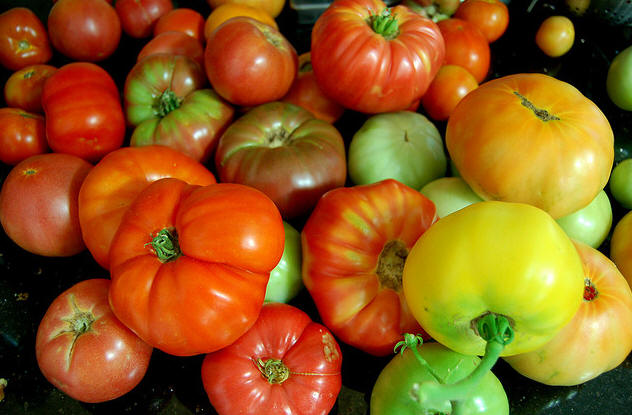
Speaking of gardens, I've also eaten about ten bazillion tomatoes this month alone. They took their sweet time ripening. But once they did, they ripened hard.
Been playing a little guitar again, too. Next month I'm going to see Bonnie Prince Billy perform in Providence so I've been teaching myself (or re-learning) a bunch of his songs. There's no better way to get inside a song, to inhabit it so to speak, then by learning how to play it.
Yesterday I went to the dentist. Next week I have my annual physical. And at some point, I need to start looking for a new car, which I'm dreading.
This is a pretty dull post, but there you have it. My September in a nutshell. I think I need some kind of excitement or something.
May 18, 2013
Working Out(side)
For my entire life I've despised yard work of any kind. Raking leaves, weeding, mowing, pruning. I hated everything about it.
This is no longer true. I have succumbed to the pleasures of working outside.
Plucking weeds and propping up the pepper plants growing in my garden is my new Friday night activity, the one thing I look forward to most at the end of the work week.Where I once watched HBO dramas and played video games, I now watch out for cabbage maggots, cutworms and aphids. Kneeling in dirt with fistfuls of manure has become meditation for me.
What's so fun about hauling dirt in an old wheelbarrow I found in the shed? The answer is everything, from fixing the broken tire axle before I could use it to the scrape of the shovel on its rusted metal inside as I scooped the dirt and spread it around.
Why, at the age of 43, did I suddenly start enjoying this sort of thing? One theory is the winter of 2013 was so brutally long that I have since gained a new appreciation for the nice weather. But I've already got my fall and winter plantings scheduled and I know that by, say late-August, I'll be looking forward to the cold once again. So it's definitely not a warm weather thing.
Could it be that I'm starting to lose brain cells and therefore seemingly mindless activities now attract my attention? No, no. Gardening is as complicated and rigorous a mental activity as you want it to be. There are planting charts to consult and structures to build, and pests to outsmart. Plus I do a lot of deep thinking out in my backyard, much more than I did watching reruns of Seinfeld.
In her blog post "The Science of How Your Mind-Wandering Is Robbing You of Happiness", Maria Popova explains how "people are less happy when they're mind-wandering, no matter what they're doing." I wonder what this means for activities like gardening. Am I being mindful when I'm ripping chunks of weed roots from the ground and shaking the loose dirt over my parsley stalks? Or am I thinking about something else, like what are my goals for the second half of my life? It's hard to know if this is being mindful or if this is mind-wandering.
I think I'll ponder this while I build a chicken-wire structure for my blueberry bushes to latch onto.
May 11, 2013
Labels of Mistrust
When it comes to food labels, I don't trust store brands.
Last week I paid $8.99 for Starbucks brand coffee instead of $5.99 for Stop and Shop's "Dark Blend", which, I should add, was placed suspiciously next to its brand name counterpart. This marketing tactic is, of course, part of the reason why I avoid purchasing generic brands in the first place. I don't like them "suggesting" that it's Starbucks. Either come out and say it or don't.
The whole thing seems dishonest to me. I don't like fuzziness and vague ideas where my food is concerned. Sure I could save a few bucks here and there, but as Sarah likes to say, cheap and inexpensive are two different things. Cheap refers to quality, inexpensive refers to price.
And that's really the issue for me. Are store brand products cheap or inexpensive?
Are those really Planter's Peanuts? Or are they some other, less desirable peanuts?
Can't you just imagine executives from Nabisco making sure all the broken Cheerios go into the private label Wheat-O's box? Just like I bet executives at General Mills tell all their workers to make sure the ugly carrots go in the Sam's Club wrappers.
Over at DelMonte foods, the production supervisor says, "Hey Sam, put the clumped-up raisins in the Wal-Mart boxes. Keep the good ones for us."
Now all of this may or may not be true. But that's really the issue here - reasonable doubt.
It stands to reason of course that there are quality controls and it's all the same ingredients, just a different box. In that case, saps like me who purchase brand names are really just grocery store rubes who waste our money and respond to marketing gimmicks.
Who knows? It could be that I just like the bright colors that accompany corporate logos and their advertising materials? Let's be honest, the Market Basket label for creamed corn looks pretty dull next to the rolling hills where the Green Giant and his kid Sprout live.
I wonder what all this says about me? Am I cynical and distrustful? Or am I prudent and cautious?
Maybe I'm just a marketing statistic, the category of "suspicious white males with disposable incomes, short attention spans and misguided (brand) loyalty."
In other words, a consumer.
Science Fiction and Science Fact
I think we need a new term to describe science-based writing, something a bit more truthful sounding than "science fiction" but not as confident as "science fact".
In science, plenty of things start out fictitious only to end up becoming reality. Flying, space travel, 3-D printing (aka replicators in Star Trek). Robots.
Even worse, many science "facts" turn out to be fiction. Milk, eggs, even fish have each gone from good to bad and back again.
This is why we need a new phrase, a word or two that captures both the uncertainty and the inevitability of discovery. For example, it is inevitable that we discover a cure for cancer but it is uncertain what this will look like.
In the strictest of scientific terms, we could say that all of science itself is Schroedinger's cat. Throw a cat in a box and leave it there for a while. Before you re-open the box, the cat is both dead and alive, a middle-ground of existence, purgatory as perception. This, to me, is the inevitability of discovery.
So what do we call science fiction? Science writing? Pop science? Futurism?
What do we call science fact? True-for-now? Proven until proven otherwise?
Stay tuned.
April 07, 2013
Twitter Me This
I just can't get into Twitter. Something about the tiny URLs and deciphering all that abbreviation turns me off.
If I liked that sort of thing, I'd be a programmer. Or a hieroglyphics enthusiast.
Take this tweet (even the terms are ridiculous, no?) from an education critic I admire.

Who could tell what he's talking about with all the @s, slashes, and parentheses?
To be fair, when you click the tweet (nope, still can't get used to it), the message is clearer.
The link brings you to a school sign that reads, "No classes this week due to state assessments. We resume your child's real education in two weeks."
Why not just re-post the sign or like it on Facebook since, chances are, that's where it originated from anyway?
Here's another one. I have no idea from where it came, nor do I know why it scrolled across my Twitter feed.
Obviously it has something to do with being Portuguese and proud. But what does it actually mean?
And why all the hashtags (formerly known as the pound sign)? It's easier figuring out the daily word jumble than deciphering tweets like this.
In fairness to Twitter users and the Portuguese , I decided to give Twitter one more chance. I clicked on one of the hashtag things and was brought to a post by someone calling herself "Jabba the Slut".
From what I could tell, it looked like Jabba was having some kind of relationship issue, perhaps with a Portuguese kid since there were about five more #s with the word Portuguese in there somewhere.
From there, I scrolled down and found another interesting tweet from Jabba, this one having to do with the properties of Portuguese urine, including how the Romans imported it as a key ingredient in ancient mouthwash. (I am not making this up).
Take this tweet (even the terms are ridiculous, no?) from an education critic I admire.
Honest sign at a middle schl: pic.twitter.com/q4e5NJfMzS (via @jjhoster). But did real education (or test prep) precede the testing?

Who could tell what he's talking about with all the @s, slashes, and parentheses?
To be fair, when you click the tweet (nope, still can't get used to it), the message is clearer.
The link brings you to a school sign that reads, "No classes this week due to state assessments. We resume your child's real education in two weeks."
Why not just re-post the sign or like it on Facebook since, chances are, that's where it originated from anyway?
Here's another one. I have no idea from where it came, nor do I know why it scrolled across my Twitter feed.
#Portuguesefacts #portuguesepride #PortugueseKids #Portuguesepower #LusoStyle pic.twitter.com/wLSV2VP5eh
Obviously it has something to do with being Portuguese and proud. But what does it actually mean?
And why all the hashtags (formerly known as the pound sign)? It's easier figuring out the daily word jumble than deciphering tweets like this.
In fairness to Twitter users and the Portuguese , I decided to give Twitter one more chance. I clicked on one of the hashtag things and was brought to a post by someone calling herself "Jabba the Slut".
From what I could tell, it looked like Jabba was having some kind of relationship issue, perhaps with a Portuguese kid since there were about five more #s with the word Portuguese in there somewhere.
From there, I scrolled down and found another interesting tweet from Jabba, this one having to do with the properties of Portuguese urine, including how the Romans imported it as a key ingredient in ancient mouthwash. (I am not making this up).
This is when I gave up.
ps: Don't forget to follow me on Twitter @DW_Wheeler #hypocrite #sellout #andeggs.
March 27, 2013
Book Recommendation
Mr. Penumbra's 24-Hour Bookstore, by Robin Sloan, follows the adventures of Clay, an unemployed twenty-something web designer who works the third shift at, what he comes to realize, is anything but a normal bookstore.
Strange customers arrive at all hours and it's Clay's job to document what each customer looks like, down to the tiniest detail, in a handwritten ledger that Mr. Penumbra keeps under the register.
Soon enough, things get interesting and Clay starts trying to figure out exactly what kind of bookstore he works at.
Part mystery-adventure, part social commentary, part fable, Mr. Sloan succeeds in mashing together more than one genre without coming off as gimmicky.
My one complaint, if you could call it that, is that reading this book makes me feel old.
Part mystery-adventure, part social commentary, part fable, Mr. Sloan succeeds in mashing together more than one genre without coming off as gimmicky.
My one complaint, if you could call it that, is that reading this book makes me feel old.
Consider the following passage where Clay decides to build a virtual model of the store to help with "data visualization". Here he describes the process of writing the code to power the software that creates his simulated store:
I have to admit that this line bothered me precisely because it did sound impressive to me.
A few pages later, Clay encounters a girl named Kat and they make plans to meet up the following morning. When he sees her again the next day, she is wearing the same red and yellow T-shirt from the day before, which leads Clay to this thought:
I liked this book. You probably will, too.
"I'm building my model of the store. It's crude - just a bunch of gray blocks slotted together like virtual LEGOs - but it's starting to look familiar. The space is appropriately shoe-boxy and all the shelves are there. I've set them up with a coordinate system, so my program can find aisle 3, shelf 13 all by itself. Simulated light from the simulated windows cast sharp-edged shadows through the simulated store. If this sounds impressive to you, you're over thirty."
I have to admit that this line bothered me precisely because it did sound impressive to me.
A few pages later, Clay encounters a girl named Kat and they make plans to meet up the following morning. When he sees her again the next day, she is wearing the same red and yellow T-shirt from the day before, which leads Clay to this thought:
"She's wearing the same red and yellow BAM T-shirt from before, which means (a) she slept in it, (b) she owns several identical T-shirts, or (c) she's a cartoon character - all of which are appealing alternatives."
I liked this book. You probably will, too.
(Trapped) Under the Dome

Even though I hadn't read one of his books since high school, and even though I was looking forward to the challenge, I have to admit to being unable to finish Stephen King's cinder block of a novel, Under the Dome.
With no resolution in sight and and 300+ pages to go (300 pages being its own large book, in my opinion), I gave up somewhere around page 700.
I kept telling myself I'd soon get back to the adventures of the residents of a small town in Maine who found themselves trapped under a dome where society starts breaking down within a matter of days. But I never did.
I liked the story and I liked the characters, but I just couldn't finish the book.
At 1,000 pages, Under the Dome is unreadable.
At 500-700 pages, it would have been a good book.
At less than 500 pages, Under the Dome would have been a great book. No question about it.
And this is the good and bad of Stephen King. The man is a writing tsunami. Sometimes this is a good thing. Sometimes it's overwhelming.
Under the Dome isn't a bad book, by any means. But unless you have a lot of time to kill, it isn't a good book, either.
March 26, 2013
Pepper Spray
I was so angry, I promptly wrote a letter and saved it to my hard drive. Here it is, for no reason other than the nice weather is coming and I find myself wondering if any of the Occupy Wall St. protesters are planning a reunion.
Dear Protesters,
What are you so mad about? (Besides the pepper spray incident, of course.)
Is this whole thing about jobs? If so, is it the prospect of either not working at all, or being forced to work a low-wage food service job to get by that has you so angry?
Maybe it’s the pressure to sell yourself to a corporation once you get out of college so you can pay off your student loans and contribute to the economy? And speaking of student loans, could it be that you're paying $30k a year to go to school when it's free in other countries? I wonder if that’s why you seem so upset. Maybe it's the healthcare debacle? Or the incarceration rate? Especially if you have friends who are immigrants, minorities, or low-level drug offenders.
Could it be the fact that buying a house in America is even more of a losing deal than it was for your parents? By the time your 30-year note is paid, you've signed away more than 10 times what you will originally pay for the property. Or is it the mortgage crisis and the fact that more than 4 million American homes were foreclosed on while big banking showed huge profits? I'm sure the CEO of Bank of America and his $9 million dollar bonus hasn't helped. And now they want to eliminate the mortgage interest deduction for homeowners?
But not everything is about money. So maybe it’s something more philosophical with you protester types, like you were raised to believe you can do anything in this country, but over time, you’ve learned the hard way that it just isn’t true? Maybe you're wondering why today's America suddenly feels like a more intolerant place than it was even a few years ago?
Or maybe you're just sick of hearing the phrase "freedom isn't free" in every new country song?
Then again, maybe it is just the pepper spray. It certainly was a mean thing to do, and I can see why you’re upset. As one commenter on YouTube put it, “when you use your body to make a point, it radicalizes a person.”
I'm sensing it was the pepper spray incident.
But don't worry. It shouldn't happen again, especially based on the swift report-writing action taken by the UC Davis leadership team. In April they issued a report that said "The decision to use pepper spray was not supported by objective evidence and was not authorized by policy."
That should fix things.
March 10, 2013
Remembering Bloom County
One of my favorite comic strips of all time is the Pulitzer Prize-Winning Bloom County, by Berkeley Breathed.
If you're not familiar with it, Bloom County was popular in the late-eighties and early-nineties. The strip followed the adventures of people (Milo, Steve Dallas, Fawn Hall) and animals (Opus the Penguin, Bill The Cat, Rosebud the Basselope) who liked to talk politics, hatch crazy schemes and contemplate life while sitting in meadows.
Breathed also published a few books, including Night of the Mary Kay Commandos and Penguin Dreams and Stranger Things.
You can see some of Breathed's favorite strips here and purchase his work here.
Here's an interview with Berkeley Breathed from 2010 talking about the re-issues of his work.
Here's Bloom County's WikiPedia page.
March 08, 2013
Braaaaiiins
I was pleased to learn that the Obama administration is dedicating significant funding to the study of the human brain. If you ask me, the brain, along with the deep ocean, are the last two places on Earth left to explore.
When you consider that researchers have just "connected" the brains of two rats (read the article here), you can see how we are only at the beginning stages of what, most likely, will turn out to be a new stage of awareness. The article points out that neither rat was necessarily aware of the other rat, only their thoughts.
The only logical next step is making one brain "aware" of the other. Given this, instead of being solely self-aware, humans are on their way to becoming multi-self-aware. Pretty wild stuff.
When you consider that researchers have just "connected" the brains of two rats (read the article here), you can see how we are only at the beginning stages of what, most likely, will turn out to be a new stage of awareness. The article points out that neither rat was necessarily aware of the other rat, only their thoughts.
"[A]n intercontinental mind-meld represents something new: a brain-to-brain interface between two live rats — one that enables realtime sharing of sensorimotor information. It's a scientific first, and while it's not telepathy, per se, it's certainly something close. Neither rat was necessarily aware of the other's existence, for example, but it's clear that their minds were, in fact, communicating. "It's not the Borg," Nicolelis tells Nature's Ed Yong. What he has created, he says, is "a new central nervous system made of two brains."
The only logical next step is making one brain "aware" of the other. Given this, instead of being solely self-aware, humans are on their way to becoming multi-self-aware. Pretty wild stuff.
February 02, 2013
Saved Articles #3 - Job Interviews
Continuing the purging of my bookmark list....
In any large or busy organization it's easy to forget the importance of thorough job interviews. All too often interviewers fall into a predictable pattern, one that often results in a less-than-engaging interview. A crappy way to start off an employment relationship, if you ask me.
Here's one guy's description of how he conducts an interview, along with some advice for recent college graduates. And like all good advice, his thoughts are applicable to most people.
Ten Things That Would Make the World a Better Place
Imagine if all people were well-versed in the following:
Philosophy
Conflict Resolution
Reading
Writing
Algebra
Scientific Principles and Methods
World History
Civics and Government
Emotional Intelligence
Technological Literacy
January 31, 2013
Saved Articles #2: Chess
![]() |
Ah, Chess. How you continue to fascinate me.
Today's post is a list of Chess tips, which I have a tendency to bookmark when I go through one of my chess phases.
And what does a "chess phase" consist of?
It usually takes place during the winter, but lazy summer days are fair game, too. This is when I find myself playing more than a few opponents at one time, usually on my iPhone using the Chess With Friends app.
As for the link above, where else can you get great advice like this?
Don’t be greedy! Sometimes you may find an easy pawn to pick up but it may be a trap (‘poisoned pawn’). Accepting it will often allow the opponent to launch a powerful attack and often the best way to neutralize is to return that material instead of trying to hold on to it.
When in trouble, remember that attack is often the best form of defense. Look for such possibility.
Do not launch a premature attack. Develop your pieces such that they coordinate well with one another and then plan your attack.Sooner or later I need to start playing some in-person games. All this technology is making me anti-social.
January 27, 2013
Saved Articles #1
I'm working my way through a very long "saved articles" list.
First up is Dumb America from the New York Review of Books blog, written by Gary Wills.
Mr. Wills is pretty forthcoming with his opinions on what he sees as obstructionist thinking. At one point he even describes the southern mentality as if "the whole continent were tipped upward, so that the scattered crazinesses might slide down to the bottom."
Here is what he has to say regarding a disrespect for science:
"No part of the country will suffer the effects of global warming earlier or with more devastation than the South, yet its politicians resist measures to curb carbon emissions and deny the very existence of climate change—sending it to the dungeon with evolution and biblical errancy. One doesn’t need much imagination to see the South with lowered or swollen waters in its rivers and ports, raging kudzu, swarming mosquitos, and record-breaking high temperatures, still telling itself that global-warming talk is just a liberal conspiracy. But it just digs deeper in denial. The South has decided to be defeated and dumb."
As for healthcare and other social issues, he has this to say:
"No one needs better health care more than the South, but it fights it off so long as Obama is offering it, its governors turning down funds for Medicaid. This is a region that rejects sex education, though its rate of teenage pregnancies is double and in places triple that of New England. It fights federal help with education, preferring to inoculate its children against science by denying evolution."
You can read the rest for yourself at the link above.
January 13, 2013
Guns, Guns, Guns
Tuesday is
the day Vice-President Biden's task force is scheduled to make gun control recommendations
to the President. Over the past few weeks, the Vice-President has met with
representatives from the gun lobby, representatives from anti-gun groups, and leaders
from the entertainment and video game industries.
In the
meantime, gun sales are booming.
This weekend,
the New York Times published an article describing picked-over gun stores with
lines of people five deep waiting to stockpile ammunition “If I had 1,000
AR-15s I could sell them in a week,” said Jack Smith, an independent gun dealer
in Des Moines, referring to the popular style of semiautomatic rifle that drew
national attention after Adam Lanza used one to kill 20 children and 6 adults at
a Newtown school."
On Friday,
the Boston Globe ran a column describing a mother and her struggles to find
mental health care for her young son. She had gone through a list of sixty-six
providers before she found mental health care provider for her son. The piece
ended with a great line by Kevin Cullen: "If the mother of that 7-year-old
boy wanted to find a Glock instead of a therapist, she wouldn’t have to go to
66 gun stores."
Something is
definitely wrong when Americans find it easier to buy assault rifles than get a
doctor's appointment.
Am I arguing
for a wholesale ban of guns? No.
One popular
argument made by gun enthusiasts is that criminals commit crimes, not guns. The
vast majority of gun owners, they say, are law-abiding citizens. This is a good
point. But it still doesn't change the fact that guns are too easily accessible
for those who shouldn't have them.
As I see it,
there are three major questions to focus on:
- How do we keep guns away from some people (criminals and the unstable)and not others?
- How do we eliminate assault-style weaponry for those who don't need such firepower?
- How do we fix what is obviously a failed system for delivering mental health services?
The first part
of the answer is more police officers, as
long as they are focused on preventative measures and not reactive law
enforcement only. Imagine if police departments were staffed enough to
conduct home visits and interviews with every member of a household where guns
are to be stored? How do we pay for it? Build it into the cost of owning a gun
and be done with it. This takes care of problem 1.
The second
question, what to do with assault rifles, is simple. Eliminate them entirely.
Average citizens do not need machine guns. Here is where the military could
help out by offering an exchange program. Turn in your assault rifle for a less
rapid-fire weapon, something suitable for protection but not warfare.
As for the
problems inherent in our mental health system, this problem is too complex for
one-size-fits-all solution. But there is something we could do in the interim
to at least provide a bit of protection. Why not require a sign-off from your
primary care physician as part of the application for a gun license?
None of these
ideas are perfect (or original), but I think they're a good start.
October 19, 2012
Time Flies Like a Bat
Seems like only yesterday I was welcoming people on the first day of school.
Every year goes by faster than the one before it.
It's easy to look at this negatively - more gray hairs, lbs that don't come off as easy as they used too, falling asleep at 9.
Then you see all the young people at school rushing through their youth, dying to graduate and be adults, and you are reminded that it's ok to slow down, to find a few minutes or an hour a day to think and appreciate where you're at.
As for my specific problem with Halloween? I'm not really sure.
The kids in their costumes are cute enough. And who doesn't like candy?
I also like a good horror movie now and then, although lately it's been more then than now.
I still don't care for Halloween, but I do love the fall season.
As for aging, my opinion on the matter remains "optimistically mixed".
August 04, 2012
Damn You, Wendell Berry
You don’t wish them any harm, necessarily.
You just wish that they weren’t so good as to make you feel inferior.
Right now this is how I feel about Wendell Berry, the farmer and writer from Kentucky, often referred to as a modern-day Thoreau.
All that keeps me from outright jealousy is the fact that you’ve probably never heard of him.
I wish I could hate him for real, or at least
harbor a strong dislike for something about the man. But it is impossible to dislike
Wendell Berry. The name alone makes sure of that. Who could hate someone named
Wendell? Or Berry, for that matter?
Consider the following
from his widely circulated speech, 17Rules for a Sustainable Community: “always ask how local needs might be
supported from local sources, including the mutual help of neighbors,” and “always
supply local needs first. (and only then think of exporting their products,
first to nearby cities, and then to others.)”.
I bet not too many folks would mind having Wendell Berry as a neighbor,
or perhaps their town’s mayor.
My current favorite Wendell quote is this:
"the most alarming state of our society now is that our leaders have the courage to sacrifice the lives of young people in war but have not the courage to tell us that we must be less greedy and less wasteful."
Check out Wendell Berry and you won't be disappointed.
July 17, 2012
Reconsidering The Pigeon
First introduced to North America in the early 1600’s, The
New York Pigeon, also known as the Rock Pigeon or Rock Dove, is easily the most
recognizable, yet underappreciated, of New York City’s wildlife.
Beyond being ignored,
the humble pigeon is often chased off, particularly when some other,
more desirable bird comes about, like the sparrow or the wren.
"Get out of here you filthy pigeons", people say. "Those crumbs are for the robins."
Even the grey
squirrel, with its chattering and rodent-like appearance gets more respect than the pigeon.
When you consider it, aside from the poop, pigeons are a whole
lot better than most critters of the city. Less intrusive than rats, less creepy than bed bugs, and friendlier than
feral cats, Pigeons have carried our messages, graced our dinner plates
(squab), and gobbled up our stale bread for centuries.
Despite this, humans haven’t really shown that much respect
for these mighty street birds. We let our dogs and cats chase them, and our
kids spray them with hoses, or shoot them with BB guns, depending upon what state you're from.
I've even heard more than a few folks
call pigeons “rats with wings” while recoiling in horror if one gets too close.
Most people forget all the good things pigeons do, like scare away mice and make peaceful cooing noises. Pigeons also eat all those slimy worms and slugs that always seem to appear on the sidewalk after a rainstorm. Plus they eat spiders, termites, and all kinds of other scary bugs.
I bet if they ate bed bugs, more New Yorkers would like them.
Here’s to the pigeon, the Bud Light of birds.
July 03, 2012
Cars of the Past
A source of never ending amusement for me is seeing some of the cars
that students drive to school.
We have plenty of multicolored cars in our
parking lot, more than a few with darkened windows, mismatched rims, and stickers
of all kinds.
One thing they all seem to have is loud speakers.
Everyone loves, or at least romanticizes, their first car. In my case, a white 1977 Cutlass Supreme with shiny wheels, a red leather steering wheel, and crushed velvet interior. I blasted Ozzy Osbourne and Metallica cassette tapes (yes, cassettes) in my friend Shawn's ear back and forth from Brockton High School for the better part of two years.
These days I listen to NPR and drive a Honda Accord.
Boooooring.
Subscribe to:
Posts (Atom)